This article contains affiliate links. We may earn a commission at no extra cost to you if you make a purchase through our links.
On This Day in 1915: When a Pacifist Asked a German War Captain About Love—at America’s Greatest Battleship Launch
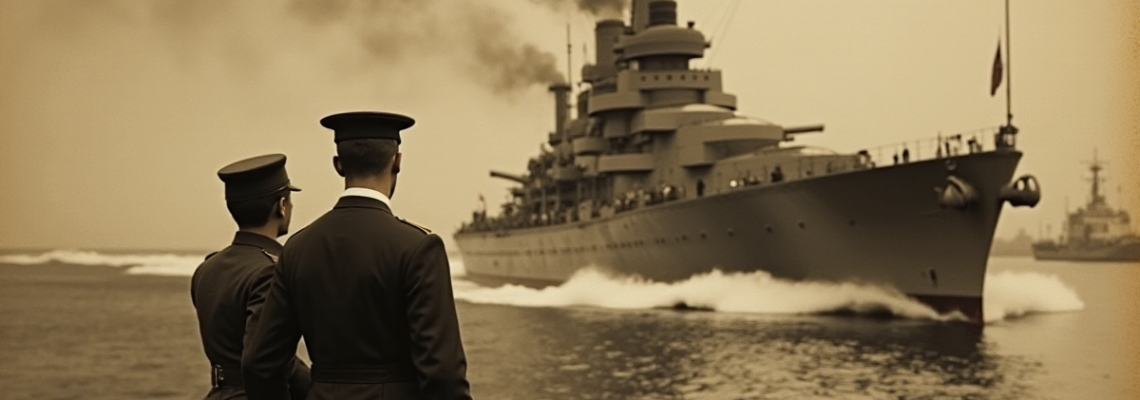
The James River at Newport News, Virginia, churned with unprecedented commotion on the morning of March 18, 1915. Thousands had gathered to witness a spectacle of American naval power: the launching of USS Pennsylvania, a 31,400-ton dreadnought battleship that was, at that moment, the largest engine of naval warfare ever built. Massive cables creaked. A brass band played. Officials in dress uniforms stood at attention on a specially constructed platform. And then, at 10 o’clock sharp, Miss Elizabeth Kolb of Germantown, Pennsylvania, raised a champagne bottle and offered not a toast but a prayer—that this monster of steel and firepower might somehow serve as “a messenger of peace, rather than a weapon of destruction.”
It was a prayer that would be tested within minutes, in a way none of the assembled dignitaries could have anticipated. Because on that platform, in full military dress, stood Commander Thierchsen of the German Navy, commanding officer of the captured German cruiser Prinz Eitel Friedrich. He had been invited to attend as part of a fragile gesture of international courtesy—a moment of civility in a world already two and a half years deep in the Great War. But his presence would spark an extraordinary human encounter, one that crystallized the anxieties and contradictions of 1915 America: powerful, growing, yet still officially neutral, preparing for a war while professing peace.
The Largest Ship in the World
The USS Pennsylvania was no ordinary vessel. At the time of her launch, she represented the cutting edge of naval technology—a dreadnought designed with massive gun batteries, advanced armor plating, and engineering that incorporated lessons learned in the early months of the Great War. She was longer than two football fields, tall as a 10-story building, and displaced more water than any warship had before. To the American public, she symbolized industrial prowess, American confidence, and the nation’s emerging role as a great power.
Secretary of the Navy Josephus Daniels had traveled to Newport News personally to oversee the launch. The presence of a German naval officer—even a prisoner-of-war commander of a captured vessel—suggested that despite the carnage in the trenches of Europe, some semblance of military protocol and gentlemanly courtesy might still prevail. The ship’s namesake, the state of Pennsylvania, had been one of the original thirteen colonies. This was meant to be a moment of patriotic pride and historical continuity.
But Commander Thierchsen’s presence created something more complicated: a living reminder that the war engulfing Europe was no longer a distant European affair. American vessels were being built explicitly to project power across the Atlantic. The guests on that platform all understood, if only dimly, that the scales of American policy were shifting. Strict neutrality was becoming increasingly untenable.
“Do You In Germany Love Us As Much As You Love Yourselves?”
As the ceremony progressed and the Pennsylvania successfully slid down the ways into the James River, the crowd’s attention scattered in different directions. Officials mingled. Naval officers shook hands. Commander Thierchsen stood beneath the towering bow of the newly launched ship, a gray-haired man in uniform, present but slightly apart from the celebration.
Then a gray-haired woman approached him. Her name was Mrs. M. F. Thomas of Beacon, New York, and she belonged to the Society of Friends—the Quakers, a religious sect historically devoted to peace and the sacred worth of every human being. She had likely attended the launch ceremony for reasons opposite to most: not to celebrate American military capability, but to witness it with concern, perhaps with prayer.
“Commander,” she said, grasping his hand directly, “I belong to a society which believes that all persons should love others as much as themselves. Do you in Germany love us as much as you love yourselves?”
It was a simple question, delivered with the straightforward moral clarity that characterizes Quaker faith. But it was also a challenge—a test of the German officer’s humanity in the face of the machinery of war he represented. The entire gathering fell silent. All eyes moved to Thierchsen.
The commander smiled, but did not answer directly. Mrs. Thomas pressed on, her voice steady: “Don’t you believe that we will soon have peace? Is it not time you men stopped killing each other?”
Now he spoke. His words, as recorded by the Nebraska newspaper correspondent present that day, carried an unsettling prophetic weight: “Madam, we all believe in peace, but this war had to be. It was a necessary war for the peace of the world. After this war there will be a long peace. But at the end of the long peace there will come another war.”
What the Words Meant
Read today, Thierchsen’s response seems almost like a curse—or a warning. In 1915, those words landed differently. Germany was not yet the clear aggressor in American popular opinion; the war was still widely seen as a complex entanglement of European imperial rivalries with no clear moral dimension. The commander’s assertion that the war was “necessary” and would bring “a long peace” reflected the thinking of European military and political elites—the belief that one more decisive war would settle the great power question once and for all, ushering in a stable international order.
But his addendum—”at the end of the long peace there will come another war”—suggested something deeper: a philosophical resignation to cycles of conflict, a belief that human nature and international competition would inevitably generate future wars. It was a dark prophecy, and utterly accurate. The Great War would end in 1918. The peace would last exactly twenty-one years. And in 1939, another and more terrible war would begin.
Mrs. Thomas had asked her simple moral question—love, peace, the golden rule—and received in return a military professional’s cynical certainty that peace, at best, was temporary.
Why This Matters Today
The encounter between Mrs. Thomas and Commander Thierchsen at the USS Pennsylvania launch represents a collision of worldviews that remains unresolved in 2026. One perspective sees conflict as the aberration—the deviation from the natural human state of cooperation and mutual love. The other sees it as inevitable, baked into human nature and international competition. One asks the moral question first. The other asks it second, if at all.
The USS Pennsylvania herself served through World War II and beyond, modernized and rebuilt multiple times, surviving into the 1950s. She became exactly what the ship’s christener had hoped and feared: a messenger of peace through strength, a deterrent, a symbol of industrial and military power. But she was also, inevitably, used as a weapon. The gap between Miss Kolb’s prayer and the ship’s actual history was the gap between intention and reality—a gap that has defined military policy for the past 110 years.
The prophetic accuracy of Commander Thierchsen’s remarks should humble us. He was wrong about many things—he could not have foreseen the atomic bomb, nuclear deterrence, or the Cold War’s decades of fragile standoff. But he was right that human societies, despite our hopes and prayers and moral convictions, seem to generate recurring cycles of conflict. Whether that cycle is inevitable, or whether new generations might finally break it, remains the central question of peace-building, arms control, and international relations to this day.
On March 18, 1915, at the launch of the greatest warship ever built, a Quaker woman asked a German officer a simple question born of faith: “Do you love us as much as you love yourselves?” His answer—honest, grim, unforgettable—was that he did, but that human nature and world politics would not permit such love to prevent war. One hundred and eleven years later, we are still wrestling with his answer.