This article contains affiliate links. We may earn a commission at no extra cost to you if you make a purchase through our links.
A Ship Trapped in a Frozen World
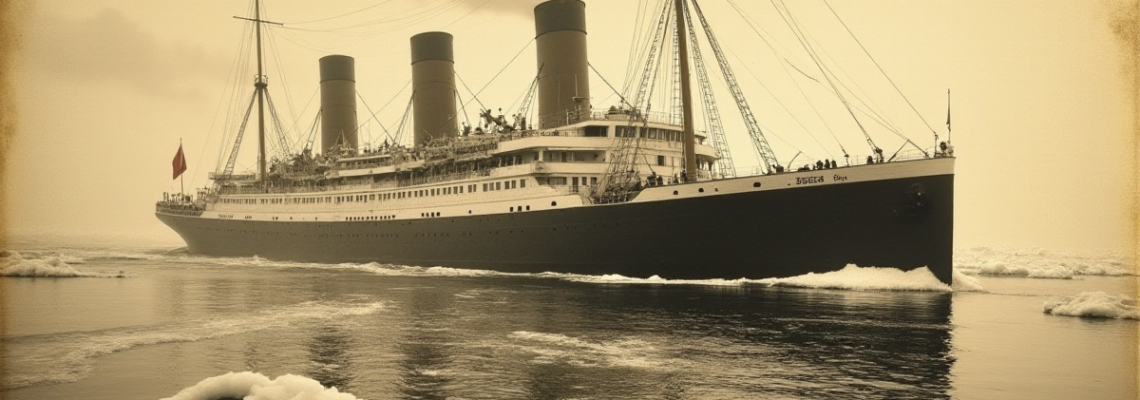
The wind howled across the deck of the Sea Queen, a sound like a dying beast, as the ship groaned against the immense pressure of the Antarctic ice. It was a world of blinding white and profound silence, broken only by the creak of timber and the snap of frozen rigging. On the bridge, Captain John Stephens—a man of adventure who had accepted a Peruvian naval commission under chaotic circumstances—gripped the cold railing. His breath plumed in the air. Before him, two men ascended the steps with murder in their eyes: First Mate Tuttle, in his shirt sleeves despite the cold, and the brutish sailor he had just threatened. Behind them, a third shadow, Bill Anderson, emerged from the hatch. Stephens backed away, his hand closing around a heavy iron pin. “You’d better keep back,” he warned, his voice cutting through the polar air. “I’m ready to brain the first man who attempts to touch me.” Tuttle stopped, his jaw working savagely. The mutiny, born of greed for a legendary treasure, had reached its boiling point.
This dramatic scene, a cliffhanger in a serialized adventure story titled The Dutch Painter, was unfolding for readers of The North Platte Semi-Weekly Tribune on March 22, 1910. While the front pages of the paper carried the mundane rhythms of small-town Nebraska—the sale of a lot for $1,000, the prediction of a dozen new automobiles, an upcoming organ recital—the inside pages held a portal to a world of high stakes on the other side of the globe. For the residents of North Platte, turning to the latest installment was an escape into a narrative where the stakes were life, death, honor, and gold.
🛡️ Browse Safely with Surfshark
VPN + Antivirus + Ad Blocker — one subscription, total protection
Get Surfshark Deal →The Plot Thickens: From Political Intrigue to Polar Treasure
The story that led to this frozen confrontation was convoluted and thrilling, a perfect product of the pre-cinema serial era. Captain Stephens, our protagonist, began as an adventurer caught up in the political tensions between Chile and Peru. After a hasty commission from a Peruvian admiral, he led a raid to capture a Chilean warship, the Esmeralda. Through a case of mistaken identity in the dark harbor, his men instead seized the private yacht of Lord Darlington, complete with the Lord’s wife and her maid.
Faced with this diplomatic catastrophe, First Mate Tuttle proposed a radical solution: instead of returning, they would sail the stolen yacht, renamed the Sea Queen, to the Antarctic. He claimed to know the location of the Donna Isabel, a ship lost in 1753 and rumored to contain a vast fortune in gold, frozen in an icy tomb. Stephens, cornered, agreed to lead the expedition. Lady Darlington, a hostage to this madness, had no choice but to place her fragile trust in the captain’s honor. Now, trapped in the ice and with the treasure presumably near, the crew’s discipline shattered. Greed overcame loyalty, and Tuttle moved to seize command.
“Lay your hands on me again,” Stephens had threatened the sailor moments before, “and I’ll floor you for good. I’ll take that grin off your face, if you attempt any further trouble with me ever.”
The tension on the bridge was a microcosm of early 20th-century anxieties and fantasies. It spoke to the era’s fascination with the last unexplored frontiers, the Antarctic representing a final geographical mystery. It tapped into the timeless allure of lost treasure. And it played on deep-seated social fears: the well-born Lady Darlington at the mercy of a mutinous, lower-class crew, her safety dependent on the mercurial morality of a rogue captain.
Life Imitates Art: The Pulse of North Platte
While readers in Nebraska followed Stephens’s struggle for survival, their own community was buzzing with the technological and social currents of 1910. The same issue of the Tribune that carried the mutiny story also reported on the “contagious” automobile fever, predicting a dozen new cars for the city. It announced a demonstration of “wireless telegraphy” by Dr. Milliner of Omaha at the Masonic Hall—a technology as futuristic to them as space travel might seem to a later generation. The local Brotherhood of Railway Engineers was planning its 28th annual May party, a testament to the strength of organized labor in a railroad town like North Platte.
There was even a subtle drama in local politics. M. Keith Neville had “positively declined” a nomination for councilman, a decision “regretted” by the paper. In his place, the ward selected Will Maloney, described as a “mighty level headed, pushing, young man.” This was the real, quiet governance of America, running parallel to the serialized screams for order on a ship’s bridge.
The newspaper served both worlds: it was the bulletin board for a growing prairie town and a window onto grand, global adventures. The serial story was not just entertainment; it was a narrative anchor, giving readers a consistent weekly thrill and a set of characters whose fates they debated at the general store or over the fence.
Why This Matters Today
The tale of the Sea Queen is more than a forgotten pulp fiction cliffhanger. It is a cultural artifact that reveals how people in 1910 processed their world. In an era before radio drama and television, the newspaper serial was a dominant form of narrative delivery. It created community through shared anticipation. The residents of North Platte, from ex-sheriff Carpenter observing the sowing of wheat to Foreman Murphy visiting his family from Sidney, would all turn to the same page to see if Captain Stephens could maintain command.
Furthermore, the story’s themes are timeless. The clash between law and survival, the corrupting power of greed, the vulnerability of the privileged in lawless situations—these are the building blocks of drama from Shakespeare to modern streaming series. The specific context—Antarctic exploration, mistaken identity, mutiny—is pure 1910, but the human emotions are instantly recognizable.
Finally, this snippet from the Tribune reminds us that history is not just a record of major wars and political treaties. It is also the story of what people read on a quiet Tuesday in March. It’s the story of how they amused themselves, what fears and hopes their popular fiction reflected, and how the rhythms of local life—baseball rivalries, church recitals, land sales—coexisted with imagined life-and-death struggles in far-off ice fields. The mutiny on the Sea Queen may not have happened, but the fact that hundreds in Nebraska were eagerly following it on March 22, 1910, tells us a great deal about who they were.
What Happened Next?
Alas, the archival page cuts off at the moment of highest tension: “Tuttle stopped, his jaw working savagely, his eyes on mine.” Readers would have to wait for the next issue of the Tribune to learn the fate of Captain Stephens, Lady Darlington, and the treasure of the Donna Isabel. Did Stephens wield the iron pin? Did Tuttle back down? Was the treasure ever found? Those answers are lost to time, buried in subsequent editions yet to be digitized or perhaps crumbled to dust.
But the legacy of such stories endures. They were the precursors to the adventure films and series we consume today. They fed a public appetite for exploration narratives that would soon be satiated by real news of expeditions like Robert Falcon Scott’s tragic trek to the South Pole in 1912. On this day in 1910, in the heart of America, the frontier spirit was kept alive not by wagon trains, but by newsprint, carrying readers from the spring thaw of Nebraska to the eternal ice of a fictional Antarctic, proving that the human need for a gripping tale is itself a historical constant.
🛡️ Browse Safely with Surfshark
VPN + Antivirus + Ad Blocker — one subscription, total protection
Get Surfshark Deal →🛡️ Total Device Protection
Surfshark Antivirus — lightweight, real-time threat detection on all devices
Get Surfshark Antivirus →