This article contains affiliate links. We may earn a commission at no extra cost to you if you make a purchase through our links.
The Raid at 2212 Washington Avenue
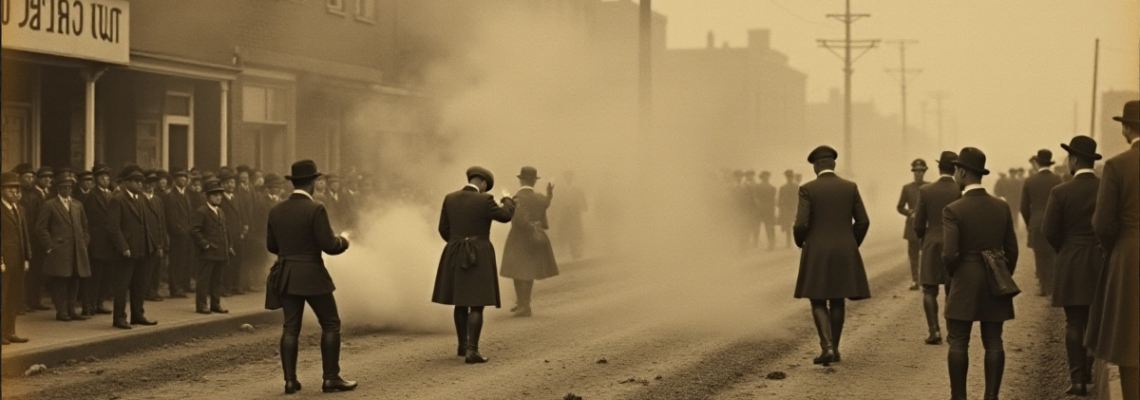
The morning of March 25, 1929, dawned chilly and gray in St. Louis, Missouri. At 10:00 AM sharp, a fleet of five black Model A Fords pulled up to the curb outside a nondescript four-story brick warehouse at 2212 Washington Avenue. Men in dark suits and overcoats emerged, their breath fogging the air. They were led by John W. H. Crim, the United States Attorney for the Eastern District of Missouri, a man with a reputation for relentless prosecution. With him were a dozen federal agents and a deputy from the U.S. Marshal’s office. They carried a warrant, but not for bootleg liquor or narcotics. Their target was face powder.
Inside the warehouse of the Whiting Manufacturing Company, manager Arthur Whiting, grandson of the founder, was overseeing the packing of hundreds of ornate cardboard boxes labeled “Luxuria,” a popular face powder brand. The agents moved swiftly, seizing the entire stock—over 40,000 boxes—and padlocking the doors. The charge, detailed in an indictment from a federal grand jury just days before, was not smuggling or adulteration, but tax evasion. The U.S. government claimed Whiting had failed to pay the federal excise tax on face powder, a 10% levy imposed not as a mere revenue stream, but as a weapon.
🛡️ Browse Safely with Surfshark
VPN + Antivirus + Ad Blocker — one subscription, total protection
Get Surfshark Deal →The Powder Tax: A Moral Crusade in Disguise
To understand the stakes of that Monday morning raid, one must look back a decade. In 1919, as Congress debated the Volstead Act to enforce Prohibition, another, lesser-known moral and economic battle was being waged. The Revenue Act of 1918 included a provision for a 10% excise tax on “any cosmetic, face powder, or toilet powder.” The tax was championed by a coalition of Progressive-era reformers and, crucially, by powerful agricultural interests led by Senator George W. Norris of Nebraska.
Their target was rice powder. For centuries, the finest face powders were made from finely milled rice starch, a luxury import. American rice farmers saw an opportunity. By taxing all face powder, but offering a complete exemption for powder made from “domestic corn, potato, wheat, or rice,” Congress aimed to devastate the import-dependent luxury powder market and force the massive cosmetics industry—pioneered by figures like Helena Rubinstein and Elizabeth Arden—to buy American. It was protectionism masquerading as sin tax, a quiet attempt to reshape a booming industry worth over $100 million annually by the late 1920s.
“The American woman’s cheek,” one Department of Agriculture bulletin stated, “should be supported by the American farmer’s field.”
The Whiting Gamble
The Whiting Manufacturing Company, however, had called the government’s bluff. Founded in the 1880s, it was a respected, mid-sized player in the toiletries field. Their “Luxuria” powder, like many high-end brands, still used imported rice starch for its unparalleled fineness and adherence. Company ledgers, later entered into evidence, showed they had paid taxes on their corn-starch-based powders but had deliberately not paid the 10% tax on Luxuria. Their argument, crafted by a sharp young attorney named Charles M. Hay, was audacious: the tax itself was unconstitutional. It was not a true tax for revenue, but a punitive and discriminatory measure designed to destroy a legitimate business in favor of a protected commodity. By not paying, they were forcing a test case.
“This isn’t about ten cents on a dollar box of powder,” Hay would later tell reporters. “It’s about whether the government can use the tax code to pick winners and losers in the private market, to dictate fashion itself from a Washington desk.”
The raid on March 25 was the government’s forceful answer. The seizure was meant to be a knockout blow, crippling Whiting’s operations and warning the entire cosmetics industry. Newspapers from the St. Louis Post-Dispatch to The New York Times carried brief notices of the “powder raid,” often buried behind stories of Al Capone’s latest troubles and President Hoover’s economic optimism. But for the women of America, who had made cosmetics a staple of modern identity, and for the hundreds of small manufacturers, the stakes were immense.
The Courtroom and the Counter
The legal battle that followed was a procedural slugfest. Whiting’s lawyers secured an injunction to get their stock back, arguing irreparable harm. The case, United States v. Whiting Manufacturing Co., wound its way through the federal courts for two years. Meanwhile, the economic landscape began to shift catastrophically. The stock market crash in October 1929, just seven months after the raid, plunged the nation into the Great Depression. Government revenue plummeted, and every stream of income became critical.
Paradoxically, the Depression also accelerated the very trend the tax was meant to stop. High-end, imported-ingredient powders became unaffordable luxuries. The market shifted decisively toward cheaper powders that happily used domestic corn and wheat starch, making the punitive aspect of the tax increasingly moot. The government’s case began to look not just aggressive, but anachronistic.
The Final Ruling and a Silent Repeal
In 1931, the U.S. Court of Appeals for the Eighth Circuit delivered its verdict. It sidestepped the grand constitutional question but ruled on narrow grounds, finding that the government’ seizure was improperly executed. Whiting got its powder back, though much of it was likely out of fashion by then. The legal precedent was ambiguous, but the practical victory went to the government’s power to levy the tax.
Yet the true end came not from the bench, but from the budget office. Facing a desperate need for revenue and recognizing the tax was now largely hitting the domestic products it was meant to help, Congress repealed the face powder excise tax as part of the Revenue Act of 1932. The four-year war on powder ended not with a judicial bang, but a fiscal whimper.
Why This Matters Today
The forgotten raid of March 25, 1929, is more than a curious footnote. It is a pristine case study in the hidden levers of policy and the unintended consequences of economic nationalism. The face powder tax was a precursor to modern trade wars and industrial policy—an attempt to use the tax code not just to raise money, but to engineer a specific market outcome, favoring one set of producers (American farmers) over others (cosmetics manufacturers and importers).
It also highlights the constant tension between government authority and private enterprise. Charles Hay’s argument—that the government was overreaching by trying to dictate the ingredients of glamour—echoes in contemporary debates over everything from energy standards to tech sector regulation. When does public interest end and punitive market manipulation begin?
Finally, the story is a reminder of how deeply our daily lives are shaped by such obscure bureaucratic battles. The face powder a flapper applied before a night out in 1929 was a political object, its price and composition fought over in congressional hearings and federal courtrooms. The products we use today are no different. The raid on a St. Louis warehouse connects, in a direct line, to the complex global supply chains and regulatory battles that define our modern economy. On this day in history, March 25, 1929, the federal government drew a line on a woman’s cheek, and American business dared to blot it.
🛡️ Browse Safely with Surfshark
VPN + Antivirus + Ad Blocker — one subscription, total protection
Get Surfshark Deal →🛡️ Total Device Protection
Surfshark Antivirus — lightweight, real-time threat detection on all devices
Get Surfshark Antivirus →