This article contains affiliate links. We may earn a commission at no extra cost to you if you make a purchase through our links.
The Unlikely Cure That Saved a Herd From Hog Cholera
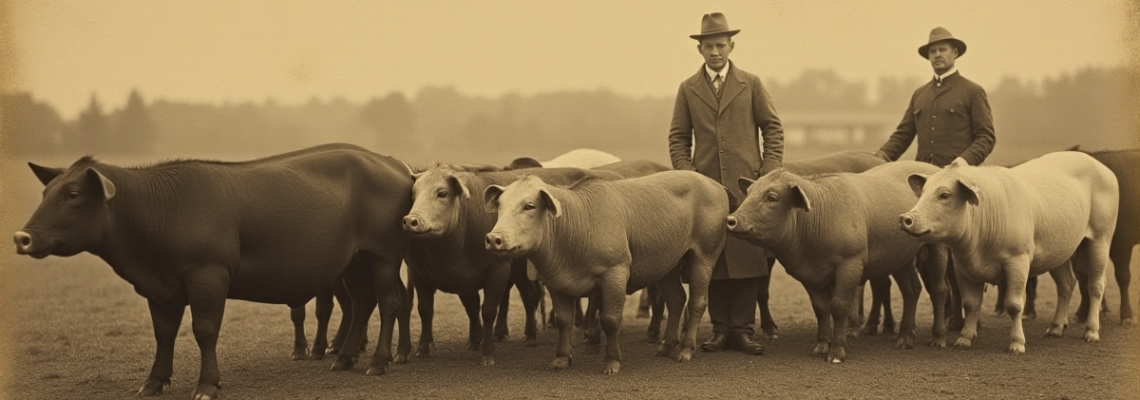
The air in the hog pen was thick with the scent of damp earth and the low, anxious grunts of sick animals. It was the spring of 1902 in Granas, Utah, and for farmer J. H. Lowrey, the specter of hog cholera—a disease that could wipe out an entire herd in days—was a constant, looming threat. But on his farm, something remarkable was happening. While other farmers watched their livestock succumb to the devastating illness, Lowrey’s hogs remained healthy, their snouts curiously blackened not from dirt, but from the unconventional remedy their owner swore by: soft coal.
On March 25, 1902, readers of The Inter-mountain farmer and ranchman in Salt Lake City encountered Lowrey’s surprising claim nestled among articles on poultry breeding. In a brief but confident letter to the editor, Lowrey detailed a practice that defied conventional agricultural wisdom. “My hog are fed soft coal almost daily through the summer,” he wrote, a statement that would have raised eyebrows among his peers who had never considered it. His hogs, he asserted, consumed the coal “with avidity,” treating it as a regular part of their diet alongside their corn.
🔒 Protect Your Privacy Online
Get up to 80% off NordVPN — the #1 rated VPN service
Get NordVPN Deal →“I do not think it necessary to feed it so liberally, yet would fear no harm in supplying them with all they will eat at all times of the year. Sherds will average upward of 40 head of all ages for the year and I calculate that 50 bushels of coal will last their pens with a daily supply.”
This was more than just a quirky farming tip; it was a potential lifeline in an era when hog cholera was the scourge of the American farmstead. The disease, caused by a virus (though this was unknown at the time), brought on fever, lethargy, and purple skin lesions, almost always ending in death. Outbreaks could decimate local economies, leaving families without a crucial source of food and income. The search for a cure or preventative was a matter of economic survival.
A Defense Against the Invisible Enemy
Lowrey’s method was born not from scientific journals, but from observation and instinct. He noticed that his hogs, when given free access to a pile of coal, would instinctively nibble on it. Trusting their judgment, he began providing it regularly. The results, he claimed, were undeniable. “I have not had a case of cholera or any other disease affecting my herd,” he stated, positioning the humble lump of coal as a “guard against disease.”
His reasoning reflected a farmer’s pragmatic understanding of animal health. He compared it to human nutrition, arguing that a restricted diet for hogs was as unhealthy as it would be for people. The coal, he believed, provided a missing mineral element that the animals instinctively sought out to regulate their systems. “In the natural state there is nothing that hogs liken which would be harmful if free access was given at all times,” he reasoned. The hogs, in their wisdom, knew what they needed for robust health.
Lowrey’s advocacy for coal feeding was a direct challenge to the agricultural establishment. At the turn of the century, farming was becoming increasingly scientific. Agricultural colleges and government bureaus were promoting standardized feeds, breeding practices, and disease management techniques. The idea that a common mineral, administered based on animal instinct, could thwart a major disease was heretical to the emerging experts. Yet, for farmers like Lowrey, who lived with the daily consequences of disease, proven results on the ground trumped theoretical science.
“Placing much faith in coal, but for the present I will make it the battle cry against swine disease in all its forms I am convinced of its merit.”
This tension between folk remedy and formal science was a defining feature of early 20th-century agriculture. Lowrey’s letter represents a voice from the front lines, sharing hard-won knowledge with his community through the pages of their local agricultural paper. He wasn’t just selling an idea; he was participating in a collective struggle for stability and prosperity against the unpredictable forces of nature.
The Scientific Blind Spot
From a modern perspective, Lowrey’s coal cure seems puzzling. We now know hog cholera is a viral infection, not a mineral deficiency. So, was he wrong? The answer is more complex. While the coal itself was not an antiviral agent, Lowrey may have stumbled upon a beneficial practice through keen observation.
Activated charcoal, a form of carbon processed to have small, low-volume pores, is used today as a detoxifying agent. It binds to toxins and chemicals in the gut, preventing their absorption. While the soft coal Lowrey used wasn’t “activated” in the modern sense, it may have had similar adsorbent properties. In an era when hogs might consume spoiled feed or encounter bacterial toxins, the coal could have acted as a digestive cleanser, improving overall gut health and making the animals more resilient to secondary infections. A healthier hog has a stronger immune system, better equipped to fight off a viral challenge. Lowrey saw the outcome—healthy hogs—and attributed it to the most obvious variable: the coal.
His story is a classic example of a correct observation leading to an incorrect conclusion, a common occurrence in the history of medicine and agriculture before the mechanisms of disease were fully understood. What mattered to his contemporaries, however, was the result. In the pages of the same newspaper, other farmers shared their own successes with coal, creating a grassroots network of anecdotal evidence that lent credibility to the practice.
Why This Matters Today
The story of J.H. Lowrey and his coal-fed hogs is more than a historical curiosity. It speaks to the enduring tension between empirical observation and institutional science. Today, we see echoes of this in discussions about regenerative agriculture, holistic farming, and the value of traditional ecological knowledge. While modern science provides invaluable tools, there is a renewed appreciation for the nuanced understanding that comes from generations of farmers working closely with the land and their animals.
Lowrey’s trust in the instinctual wisdom of his hogs—”known better to their own instinct and combination for the best result”—foreshadows contemporary interests in animal welfare and natural behaviors. The move away from extreme confinement in agriculture is partly driven by the recognition that allowing animals to express natural behaviors leads to better health outcomes. Lowrey was, in his own way, an early proponent of listening to the animals in his care.
Ultimately, the hog cholera saga itself had a profound conclusion. After decades of research, a reliable vaccine was developed, and a massive federal eradication program began in the 1960s. On January 31, 1978, the United States was officially declared free of hog cholera, one of the great success stories of veterinary public health. J.H. Lowrey’s coal cure was relegated to the footnotes of history, a temporary, intuitive shield against a foe that would eventually be vanquished by science.
But on this day in history, March 25, 1902, for the farmers of Utah reading The Inter-mountain farmer and ranchman, it was not a footnote. It was a beacon of hope, a practical tip from a neighbor that might just save the season’s bacon. It reminds us that history is often written in the small, desperate innovations of ordinary people facing extraordinary challenges, their solutions etched not in textbooks, but in the rich, dark soil of their own experience.
🔒 Protect Your Privacy Online
Get up to 80% off NordVPN — the #1 rated VPN service
Get NordVPN Deal →🔒 Stop Reusing Passwords
NordPass generates and stores strong passwords across all your devices.
Try NordPass Free →