This article contains affiliate links. We may earn a commission at no extra cost to you if you make a purchase through our links.
The Night the Sky Fell on a Texas Town
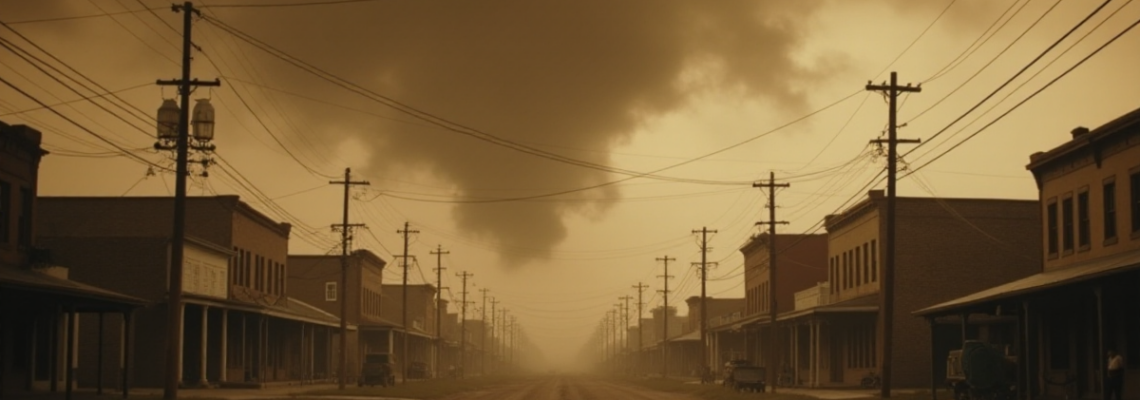
The sound came from nowhere and everywhere at once. It was shortly after 9 p.m. on Tuesday, March 25, 1930, in Wichita Falls, Texas. The air, cool and still, was suddenly torn by a deep, percussive boom that rattled windowpanes for miles, shook dishes from shelves, and sent dogs howling into the night. On the city’s north side, near the oil refineries and railroad yards, the concussion was so violent it blew out plate-glass windows in storefronts along Indiana Avenue. Men and women, weary from another day of scraping by in the deepening grip of the Great Depression, rushed into the streets, their faces etched with a primal fear. Some looked skyward, expecting to see a storm, but the stars were clear. Others, thinking of the recent oil boom’s volatile infrastructure, scanned the horizon for a fireball. There was nothing. Just the lingering, metallic echo in the ears, and a profound, unsettling silence.
This was no ordinary sonic event. In an era before jet aircraft or space debris, a mystery of this magnitude seized a community whole. The Wichita Falls Times would call it “the most terrifying unexplained phenomenon in the city’s history.” The police switchboard lit up like a Christmas tree. Callers from every corner of the county reported the same thing: a single, massive explosion with no visible cause. Had a boiler burst at the Cosden refinery? A dynamite truck overturned on the Jacksboro Highway? A secret military test gone awry from nearby Fort Sill? Theories, fueled by anxiety, flew faster than facts.
🔒 Protect Your Privacy Online
Get up to 80% off NordVPN — the #1 rated VPN service
Get NordVPN Deal →A Community on Edge
To understand the panic, one must understand the moment. March 1930 was a precarious hinge in American history. The stock market crash was just five months old. The full, devastating weight of the Depression was settling in, but the shape of the hardship was still unclear—a gathering storm cloud. In North Texas, the economy was a patchwork of fading agricultural prosperity and the still-bubbling, risky business of oil. Wichita Falls was a hub for both. Men like independent wildcatter Tom Slick had made fortunes in the nearby Panhandle fields, but for every gusher, there were a dozen dry holes and mounting debt. Uncertainty was the currency of the day.
Into this atmosphere of collective nerves dropped the “Wichita Falls Boom.” The initial official response was one of bemused dismissal. Police Chief John McGrath told reporters he believed it was simply a “freak atmospheric disturbance,” a conclusion that satisfied no one who had felt their house tremble. The city’s sole seismograph, operated by the geology department at Hardin College (now Midwestern State University), had registered a distinct tremor at 9:07 p.m., but its readings were crude. The lack of a crater, fire, or casualty list only deepened the mystery.
The Hunt for an Answer
Within days, the story took on a life of its own, spilling beyond Texas. The Associated Press picked it up, and soon papers from the New York Times to the Los Angeles Examiner were running briefs about the “Texas Sky Mystery.” This brought the theorists out in force. The most prominent explanation, championed by several scientists quoted in the national press, was that the boom was caused by a large meteorite exploding in the upper atmosphere—a phenomenon later understood as a bolide. Dr. Charles H. Smith, an astronomer from Austin, suggested a “cosmic missile” had detonated miles above the earth, its sound waves focused downward by atmospheric conditions.
But in the flat, open country around Wichita Falls, people had their own ideas. Ranchers north of the Red River called in reports of a “strange, shimmering light” moving southwest to northeast just before the blast. An elderly farmer near Electra swore he saw a “ball of fire the size of a washtub” streak silently across the sky and vanish. These accounts, though inconsistent, fed into a popular narrative of a meteorite strike. Expeditions of local boys and oilfield roughnecks fanned out across the prairie, hoping to find a precious, star-born nugget that could solve their financial woes in one fell swoop. They found nothing.
The alternative theories were a snapshot of 1930s anxieties. Some whispered about secret experiments by the Army Air Corps, testing new explosives or even early rocketry. Others, reflecting the era’s spiritualist undercurrents, wondered if it was a sign—a portent of the economic or even apocalyptic turmoil to come. The lack of a definitive answer allowed the event to live in a space between fact and folklore.
What Happened Next?
The immediate frenzy faded with the news cycle. No crater was discovered. No meteorite fragments were ever officially verified. The police closed their investigation. For the people of Wichita Falls, the boom became a marker in time—a story grandparents would tell, an “I remember exactly where I was” moment long before such phrases were common.
However, the event’s true legacy is scientific. The Wichita Falls boom of 1930 became a key case study in the annals of meteoritics. It occurred at a time when the science of tracking meteors and their atmospheric impacts was in its infancy. Decades later, researchers re-examining the seismic data and hundreds of similar reports worldwide would classify it as a probable “airburst” of a stony asteroid, perhaps 5-10 meters in diameter, exploding with the force of several kilotons of TNT high in the mesosphere. It was a cousin to the far more devastating 1908 Tunguska event in Siberia, and a precursor to understood phenomena like the 2013 Chelyabinsk meteor in Russia.
Why This Matters Today
The night the sky fell on Wichita Falls matters because it represents a collision between human perception and a vast, indifferent universe. In our modern age, equipped with global infrasound networks and smartphone cameras, a similar event would be tracked, recorded, and explained within hours. In 1930, it was a profound rupture in the normal order, interpreted through the lens of local industry, economic fear, and limited science.
It also serves as a humble reminder of our planet’s place in a dynamic solar system. The Earth moves through a swarm of spaceborne debris, and interactions like the one on March 25, 1930, are not rare historical flukes but regular occurrences. Most burn up harmlessly over oceans or uninhabited areas. The Wichita Falls event was a statistical inevitability—a town happened to be underneath it.
Today, the story endures not in official monuments, but in local archives and family lore. It’s a testament to how communities process the unexplainable, weaving narratives to fill the void until science can catch up. The boom was a momentary crack in reality for a Depression-weary town, a shared experience of wonder and terror that, for one night, made the struggles of the ground beneath their feet seem small against the mysteries raining down from the sky above.
“It wasn’t like thunder. It was a hard, sharp crack, like the world itself splitting open. And then… nothing. Just the quiet, and the feeling that something enormous had just passed us by.” — Recollection of Mary-Louise Carter, 12 years old on March 25, 1930.
So, on this day in history, March 25, we remember not a battle or a treaty, but a sonic boom from the heavens—a reminder that sometimes, history is written not by people, but by the silent, fiery passage of a rock from the depths of space, leaving only a question hanging in the Texas air.
🔒 Protect Your Privacy Online
Get up to 80% off NordVPN — the #1 rated VPN service
Get NordVPN Deal →🔒 Stop Reusing Passwords
NordPass generates and stores strong passwords across all your devices.
Try NordPass Free →