This article contains affiliate links. We may earn a commission at no extra cost to you if you make a purchase through our links.
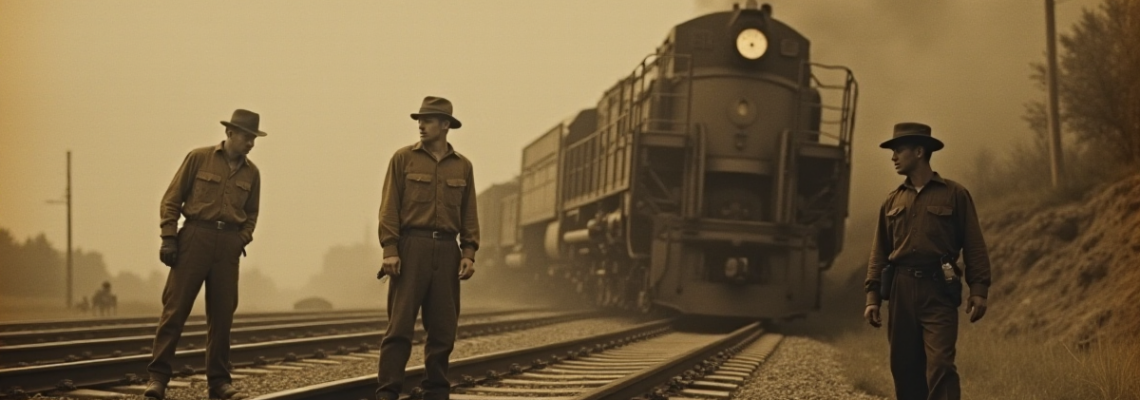
The caboose shuddered, a violent lurch that felt wrong in the bones. It was a routine switching maneuver in the quiet yards near Tylertown, Mississippi, on or just before March 24, 1952. E. R. Pennington, a flagman for the Gulf, Mobile & Ohio Railroad, was riding the rear platform, a man doing his job on a stretch of track far from the headlines. Then the wheels left the rails. In the chaos of the derailment, as the small crew scrambled, Pennington was overrun by his own train. The official report, when it was filed, would be a dry, bureaucratic form. But in the pages of the Trainman News, the weekly voice of the Brotherhood of Railroad Trainmen, Pennington’s death was more than a statistic. It was a stark, human punctuation mark in a much larger and more ominous story unfolding in Washington, D.C.—a story of a regulatory body sounding an alarm that few outside the rail yards would hear.
A Death in Tylertown and a Brotherhood’s Loss
E. R. Pennington of Lodge 770 was a veteran railroader. He’d joined the GM&O in 1941 and the Brotherhood of Railroad Trainmen (BRT) in 1942, putting in a solid decade of service in one of America’s most essential and dangerous trades. His death was the kind of accident that happened with grim regularity in an industry built on steel, momentum, and human vigilance. The Trainman News gave him a brief, respectful notice, a testament to the tight-knit, often perilous world of railroad men. His story, in a different era, might have ended there—a private tragedy for his family and lodge.
🛡️ Browse Safely with Surfshark
VPN + Antivirus + Ad Blocker — one subscription, total protection
Get Surfshark Deal →But on that same date, March 24, 1952, the newspaper’s lead story broadcast a chilling federal warning that framed Pennington’s death in a new and alarming light. The Interstate Commerce Commission (ICC), the powerful agency tasked with regulating railroad safety and economics since 1887, had issued its annual report. Its message was dire: America’s railroad safety net was being systematically dismantled, not by law, but by ledger.
“Altho the Congress has since 1940 repeatedly expanded the commission’s regulatory powers, de-regulation is increasing thru the gradual but steady reduction of the appropriations for the commission each year.”
The ICC called it a “left handed reduction in effectiveness.” With budgets shrinking, safety work was being curtailed. Inspectors couldn’t travel as much. The commission admitted it lacked the staff to properly police accident reports, leading to “highly inaccurate” statistics. Most damningly, the report noted the recent invalidation of the “Form T” accident report, which had required railroads to supply names and locations of the injured and killed. Now, the carriers could hide the true toll. “The public becomes more and more helpless and defenseless as a result,” the ICC charged. For workers like Pennington, this wasn’t abstract policy. It meant the mechanisms designed to investigate why a caboose derailed, to enforce standards that might have prevented it, and to honestly record his death, were being starved into silence.
The Hidden War: Deregulation by Defunding
The post-war America of 1952 is often remembered for its booming industry and suburban optimism. Yet beneath that surface, a quiet struggle over the soul of the New Deal regulatory state was raging. The ICC’s report pulled no punches: budget cuts were a gift to the “railroad lobby,” which was “pressing for a still freer hand for the carriers.” This was deregulation by stealth—achieving through appropriations committees what could not yet be won in a full Congressional vote.
The stakes for workers were existential. Without robust ICC oversight, accident prevention faltered. “There can be no backlog in safety work of this nature,” the report insisted, referring to the inspection of unsafe conditions. A backlog, however, was precisely what was being created. Every unfilled inspector position, every un-traveled mile of track for inspection, increased the statistical probability of another Tylertown. The Brotherhood of Railroad Trainmen, representing over 500,000 members, understood this intimately. Their newspaper’s juxtaposition of Pennington’s obituary with the ICC’s stark warning was a deliberate act of storytelling. It connected a single man’s fate to a systemic betrayal.
A Continent Away, A Different Boom
In sharp contrast, another story in the same issue hinted at the global forces shaping the era. A report from Canada detailed a “booming” base metal industry, fueled by post-war development and Korean War defense needs. Massive projects like the 360-mile railway being carved into the Labrador-Quebec wilderness to tap iron ore reserves spoke of a world investing heavily in infrastructure and extraction. This expansive, confident nation-building stood in stark relief to the scene in Washington, where the guardians of America’s own foundational infrastructure—its rail network—were pleading for resources to keep it safe for the men who ran it.
What Happened Next? The Long Arc of Safety and Secrecy
The immediate aftermath of the ICC’s 1952 warning is a story of muted impact. The public, preoccupied with the Red Scare and the Korean War, largely missed the report. The railroad lobby remained powerful. Budgetary pressure on regulators became a perennial tactic. The specific tragedy of E. R. Pennington faded from public memory, one of thousands of industrial fatalities that marked the mid-century.
Yet, the themes of that March 24 report resonate through decades. The tension between corporate autonomy and public safety regulation never disappeared. The tactic of weakening agencies through “starving the beast” funding strategies became a political hallmark. And the struggle for transparent accounting of workplace deaths remains shockingly relevant; the fight over accurate injury logs and the suppression of workplace data are battles still fought by unions today.
The Brotherhood of Railroad Trainmen continued its advocacy, eventually merging into the United Transportation Union in 1969. Railroad safety would see improvements driven more by catastrophic disasters that captured national attention and by technological change than by the unheeded warnings of underfunded regulators. The ICC itself would be dissolved in 1995, its functions scattered, its era of peak power a memory.
Why This Matters Today
The story of March 24, 1952, matters because it is a masterclass in how political and economic change often happens not in dramatic, televised votes, but in the quiet, dry corridors of budget offices. The “left-handed reduction” described by the ICC is a timeless playbook: achieve policy goals not by winning the debate on the merits, but by crippling the ability of your opponent to function. When we see debates today about funding for environmental protection, workplace safety (OSHA), or consumer financial oversight, we are watching a modern version of the same struggle the ICC detailed 72 years ago.
It also matters because it recovers the human cost embedded in those budgetary line items. E. R. Pennington was a real person with a family and a union lodge. His death may have been an accident, but the system’s ability to learn from it, prevent the next one, and honor his loss was deliberately compromised by political choices made hundreds of miles away. It reminds us that history is often found not in the sweeping headlines, but in the small-type notices of the trade press, where the consequences of power reveal themselves in the lives of ordinary people.
Finally, it underscores a perpetual conflict in American life: the battle between the recorded truth and the obscured fact. The ICC’s lament over the loss of “Form T” and the resulting “highly inaccurate” accident statistics is a fight over narrative. Who controls the data controls the understanding of a problem. In an age of information and disinformation, the 1952 railroad lobby’s push to hide the names of the killed and injured is a primitive but potent form of narrative control—one that feels all too familiar in our own time. On this day in 1952, a railroad flagman died, and a government agency wrote his epitaph in the form of a warning we are still learning to heed.
🛡️ Browse Safely with Surfshark
VPN + Antivirus + Ad Blocker — one subscription, total protection
Get Surfshark Deal →🛡️ Total Device Protection
Surfshark Antivirus — lightweight, real-time threat detection on all devices
Get Surfshark Antivirus →