This article contains affiliate links. We may earn a commission at no extra cost to you if you make a purchase through our links.
On This Day in 1953: The Morning Turkey’s Marmara Region Shattered
The morning of March 18, 1953 broke like any other in the Marmara region of western Turkey. Shopkeepers were opening their doors along the streets of Yenice and Gönen. Farmers were already in the fields outside these modest towns, working the rich agricultural land that had sustained the region for centuries. Children were heading to school. By mid-morning, the sun was climbing into a clear Turkish sky—the kind of day that promised spring after a long winter.
Then, at 6:27 AM, the earth stopped keeping its promises.
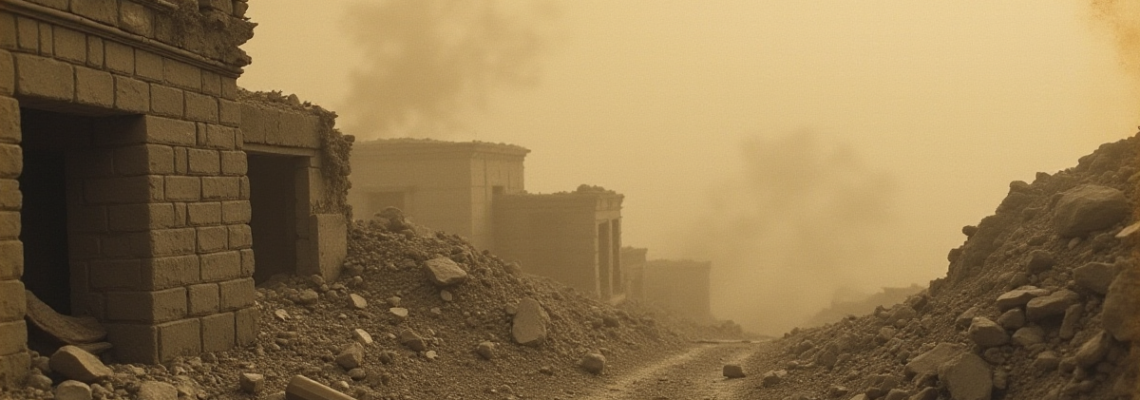
The ground beneath western Turkey rolled, buckled, and split apart with a ferocity that the 1950s had barely begun to understand. A magnitude 7.2 earthquake tore through the Yenice-Gönen fault zone, one of the most seismically active regions on Earth. In the span of forty-five seconds, entire villages were erased. Mud-brick homes and Ottoman-era stone buildings crumbled like sand castles. Roads cracked open. The very infrastructure of this corner of Turkey—railways, bridges, water systems—fractured into uselessness. When the shaking finally stopped, at least 1,070 people were dead, and the social fabric of an entire region was torn.
What happened on March 18, 1953, was not just a natural disaster. It was a reckoning with Turkey’s vulnerability, a test of its young republic’s ability to respond to catastrophe, and a turning point in how the nation would understand the geological forces beneath its feet.
A Nation Rebuilding
To understand the earthquake’s impact, we must first understand Turkey in 1953. The nation was barely three decades old. Mustafa Kemal Atatürk’s revolution had transformed the remnants of the Ottoman Empire into a modern secular state, but that modernity was still being constructed, still being tested. In 1953, the government was led by Prime Minister Adnan Menderes and President İsmet İnönü, pragmatic politicians focused on rapid modernization and economic development.
Turkey was ambitious. The country was industrializing at a pace that rivaled Western Europe. New roads were being built. Railways were being modernized. Cities were expanding beyond their ancient walls. This was a moment of national confidence, of forward momentum.
The Marmara region—the area encompassing the Sea of Marmara and the lands surrounding it—was central to this vision. It was where East met West, where Turkey’s ancient capital Constantinople (now Istanbul) still stood as the gateway to Europe. It was economically vital and symbolically charged. The towns of Yenice and Gönen sat on the southern shore of the Marmara, in what is now the province of Bursa—towns that had survived Ottoman conquest, two world wars, and the Turkish Revolution.
They would not survive what came next.
The Geological Reality Below
The Marmara region sits atop one of the world’s most active fault systems. The North Anatolian Fault, a massive strike-slip fault that runs roughly east-west across Turkey, passes directly through the region. This fault is the boundary between the Eurasian Plate and the Anatolian Plate—two vast pieces of the Earth’s crust locked in a slow, grinding dance that has lasted for millions of years.
That morning, the strain that had been building along the Yenice-Gönen segment of the fault finally snapped. The release of accumulated energy was sudden and violent. The ground didn’t simply shake—it jumped, moved laterally by several meters. Villages that had stood for centuries found themselves on opposite sides of a new topographical divide. The earthquake’s energy radiated outward in waves, reaching Istanbul to the north and spreading across the entire western region.
But in 1953, Turkey had almost no seismic network, no early warning system, no real understanding of where or when earthquakes would strike. The nation had no centralized disaster response protocol. When the earthquake came, it came as a complete surprise.
The Terrible Arithmetic of Collapse
In Yenice, entire neighborhoods vanished. The main bazaar, where merchants had sold their wares for generations, was reduced to rubble. The town’s hospital—the only significant medical facility in the region—collapsed, killing doctors and patients alike. Rescue workers arriving in the aftermath found scenes of impossible devastation: families buried under mud and stone, livestock mixed with human remains, roads so completely destroyed that reaching the towns required walking through fields and climbing over wreckage.
Gönen suffered similarly. The earthquake destroyed homes, schools, and administrative buildings. Survivors wandered through streets they no longer recognized, calling out names of missing family members. The initial death toll was unclear—communication systems were down, roads were impassable, and accurate accounting seemed impossible in the immediate chaos.
The Turkish government responded with characteristic pragmatism. Military units were dispatched to provide emergency aid. Relief supplies were organized. The government declared the affected regions disaster areas and began organizing reconstruction efforts. By the standards of 1950s disaster response, Turkey’s reaction was relatively swift and organized. But the scale of the disaster still overwhelmed the nation’s capacity to help.
International aid began to arrive. The United States, NATO ally and regional powerbroker, sent assistance. Neighboring countries contributed supplies and medical personnel. But for the survivors in Yenice and Gönen, this aid often arrived too slowly, in too small quantities, in the wrong forms. People who had lost everything were living in temporary shelters made of canvas and wood. Medical care was still scarce weeks after the disaster. The psychological trauma was immense.
A Turning Point for Turkish Science
The 1953 earthquake became a catalyst for change in Turkey. The government, shaken by its own unpreparedness, began to invest in understanding Turkish geology and seismic risk. The Kandilli Observatory and Earthquake Research Institute in Istanbul, which had existed since 1868, was expanded and modernized. Turkish scientists began systematic study of the North Anatolian Fault. Networks of seismic stations were gradually installed across the country.
The earthquake also spurred changes in building codes. Turkish architects and engineers began, however slowly, to design structures that could withstand seismic activity. This was not an overnight transformation—Turkey would suffer more devastating earthquakes in the decades that followed, including the catastrophic 1999 Izmit earthquake that killed over 17,000 people. But the seeds of change were planted in 1953.
Why This Matters Today
Seventy years later, the 1953 Yenice-Gönen earthquake remains relevant precisely because it was a harbinger of vulnerability that persists. The Marmara region remains one of the world’s most seismically active zones. Scientists have long warned that another major earthquake on the North Anatolian Fault—potentially a magnitude 7.5 or higher—could strike the region at any moment. Istanbul, a megacity of 15 million people built on a foundation of geological instability, sits in the path of this looming threat.
The 1953 earthquake taught Turkey that geology does not respect national borders, political ambitions, or development schedules. It taught that earthquakes are not rare anomalies but regular events along certain fault lines, and that preparation—not surprise—must be the default assumption. Yet that lesson is one that Turkey has had to relearn repeatedly, with each successive disaster.
The earthquake also revealed something about human resilience. The communities devastated in 1953 rebuilt. Yenice and Gönen were reconstructed. Life resumed. But the memory of that morning—when the earth itself became a force of destruction—has never fully faded from the regional consciousness. It serves as a reminder that beneath the modern world we build, ancient geological forces continue their slow, patient work, indifferent to human hope or human engineering.
A Forgotten Catastrophe?
Today, the 1953 Yenice-Gönen earthquake is largely forgotten outside Turkey, overshadowed in historical memory by larger disasters and more dramatic events. But in the communities that were there—in the descendants of survivors who rebuilt their lives from the rubble—it remains a defining moment. It is a date that marks a before and after: the world that existed until 6:27 AM on March 18, and the world that came after.
What happened on this day in 1953 was not just the release of geological energy. It was a rupture in the fabric of ordinary life—one that the people of the Marmara region spent decades mending. It was a wake-up call that Turkey, for all its ambitions of modernity, remained vulnerable to forces beyond its control. And it was a reminder that history is not only written by great leaders and grand ideas, but also by the sudden, violent upheavals that reshape entire regions in moments.
The earth beneath Turkey continues to move. The faults continue to stress and slip. The next rupture will come—when, no one knows. But because of what happened on March 18, 1953, Turkey knows it is coming. That hard-won knowledge, paid for in lives and loss, remains the most important legacy of that devastating morning.